
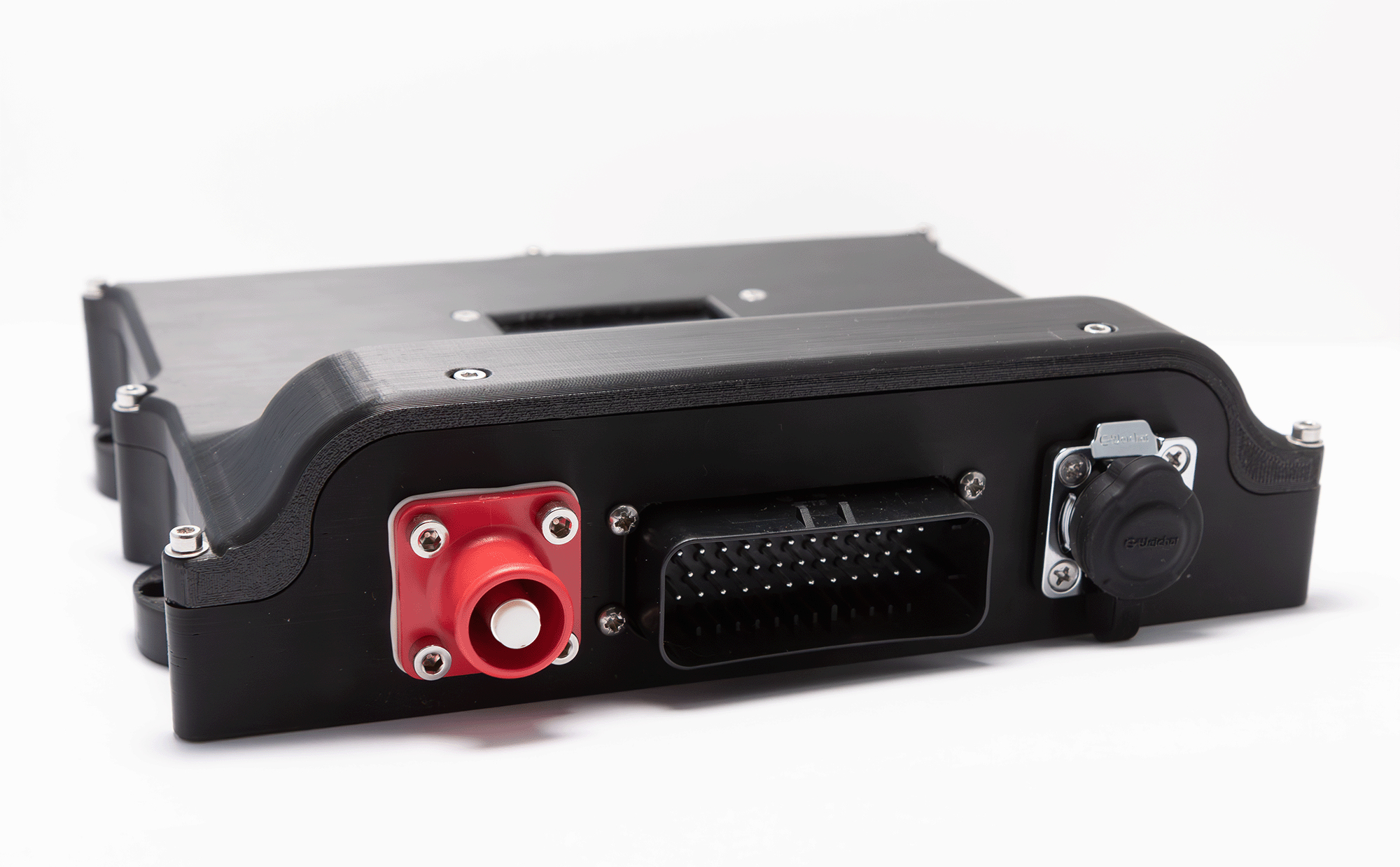
Whether you’re building a race car, rally car, drift car, off-road vehicle or a bespoke road car, the electrical system is one of the most critical parts of the build. Traditional fuse boxes and relays have served the automotive industry well for decades, but modern Power Distribution Modules (PDMs) offer significant advantages in reliability, flexibility and diagnostics.
However, not all PDMs are created equal. While many appear similar on paper, the differences often become apparent once they’re installed and relied upon in demanding conditions. If you’re considering a PDM for your next project, here are the features worth looking for.
Reliability comes first
A PDM sits at the heart of your vehicle’s electrical system. If it fails, chances are your vehicle isn’t going anywhere. For that reason, reliability should be your first consideration. Most modern PDMs use solid-state high-side switches instead of mechanical relays. With no moving contacts to wear out, they offer silent operation, fast switching and excellent long-term reliability.
It’s also worth considering how the hardware has been designed. Features such as effective thermal management, quality PCB layout, adequate copper thickness and robust connectors all contribute to long-term reliability, particularly in environments exposed to vibration, moisture and temperature extremes. Standby current is another specification that’s often overlooked. If your vehicle spends weeks between outings, every milliamp matters. A well-designed PDM should consume very little power while asleep and provide flexible wake-up options such as an ignition input or CAN bus activity.
Intelligent circuit protection
One of the biggest advantages of replacing traditional fuses is configurable electronic protection. Rather than simply blowing a fuse, a modern PDM can detect faults and respond intelligently.
Look for features such as:
- Configurable current limits
- Short-circuit protection
- Over-temperature protection
- Current monitoring
- Automatic retry after faults
- Open-load detection
This not only protects your wiring but can also make diagnosing faults considerably easier.
Don’t just count outputs
It’s tempting to compare PDMs purely on the number of outputs they provide, but this rarely tells the whole story.
Instead, consider:
- Continuous current per output
- Total combined current capacity
- PWM capability for dimming or speed control
- Output current monitoring
- Configurable protection on each channel
In many cases, a well-designed 14-output PDM will outperform a cheaper 20-output unit with limited current capability or fewer software features.
CAN bus integration
Modern aftermarket ECUs make extensive use of CAN bus communication, and your PDM should too. Integration with systems from manufacturers such as Haltech, Link ECU, MoTeC, ECUMaster and MaxxECU allows the PDM to make decisions based on real vehicle data rather than relying solely on switched inputs.
Outputs can respond automatically to supported CAN messages, allowing the PDM to react to information such as engine speed, coolant temperature and other vehicle data without relying solely on switched inputs. This reduces wiring complexity while enabling much more intelligent control strategies.
Diagnostics save time
Electrical faults are frustrating enough without having to chase them with a multimeter for hours. A good PDM should provide detailed diagnostics, allowing you to see exactly what happened if a circuit shuts down.
Useful features include:
- Live current measurements
- Supply voltage monitoring
- Output status
- Fault history
- Internal temperature monitoring
- Event logging
Whether you’re supporting customers remotely or diagnosing an issue in the paddock, good diagnostics can dramatically reduce troubleshooting time.
Remote connectivity
Most PDMs stop communicating the moment you unplug your laptop or walk away from the vehicle. An integrated cellular modem opens up an entirely different level of capability.
Instead of requiring physical access to the vehicle, remote connectivity creates opportunities for features such as:
- Monitoring battery voltage from anywhere
- Receiving fault notifications
- Remote diagnostics
- Vehicle status monitoring
- Fleet management
- Security applications
Even for privately owned vehicles, being able to check on a vehicle that’s stored for weeks or months can provide valuable peace of mind.
As connected vehicles become increasingly common, integrated cellular connectivity provides a platform for future features that simply aren’t possible on standalone PDMs.
GPS is more than vehicle tracking
GPS is often thought of purely as a theft recovery feature, but it can provide much greater value when integrated directly into the PDM.
Potential applications include:
- Journey logging
- Route history
- Vehicle tracking
- Speed logging
- Geofencing
- Rally support
- Fleet management
Because the GPS receiver is built into the module itself, there’s no need for additional hardware or external interfaces to begin taking advantage of location data.
Motion sensing adds another dimension
An integrated Inertial Measurement Unit (IMU) is still relatively uncommon in automotive PDMs, but it opens up a wide range of possibilities.
By measuring acceleration and movement, an IMU can be used for functions such as:
- Motion-based wake-up
- Detecting when a stored vehicle has been moved
- G-force logging
- Crash detection
- Orientation monitoring
Like GPS and cellular connectivity, an onboard IMU provides hardware capability that software can continue to build upon over time.
Choose a platform that can grow
A PDM isn’t just another electrical component—it’s the centre of your vehicle’s electrical system. As projects evolve, requirements inevitably change. Additional lighting, cooling systems, sensors, displays and accessories all place new demands on the electrical architecture.
Choosing a platform designed with expansion in mind helps protect your investment.
Whether that’s additional I/O modules, new communication interfaces, cloud services, software updates or tighter integration with other products, an expandable ecosystem allows the system to evolve alongside the vehicle rather than requiring a complete replacement.
Software is just as important as hardware
Unlike traditional relay and fuse boxes, a PDM can continue to improve long after it’s installed.
Regular firmware updates can introduce new features, improve performance and expand compatibility with additional hardware, all without changing the electronics.
When comparing products, it’s worth considering not only what the PDM can do today, but also how actively it’s developed and whether the platform has a clear roadmap for future functionality.
Final thoughts
Choosing a Power Distribution Module isn’t simply about replacing a fuse box—it’s about selecting the foundation of your vehicle’s electrical system.
Look beyond output count and headline current ratings. Consider the quality of the hardware, the software behind it and how the platform fits into your long-term plans.
Features such as intelligent circuit protection, comprehensive diagnostics, CAN bus integration, low standby power consumption and integrated connectivity can make a significant difference to both reliability and usability.
Perhaps most importantly, choose a platform that has room to grow. A PDM should continue adding value as your vehicle evolves, not become another component that needs replacing when your ambitions outgrow its capabilities.
